




A team of researchers from Tohoku University and Meidensha Corporation have successfully developed an algorithm that minimizes power loss during the distribution process by changing the distribution network configuration. The team, which has been researching power distribution since 2015, has also submitted joint patent applications for the algorithm. Such a discovery leads to greater energy efficiency and reduced carbon dioxide emissions.
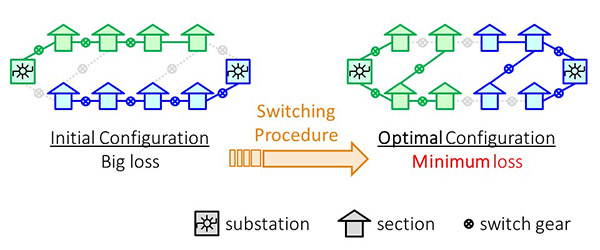
Choice of network configurations ⒸTohoku University
The algorithm calculates not only an optimal network configuration but also a procedure for switching to the configuration, allowing for wide-application to a variety of practical situations in existing power distribution systems. This was a joint research project carried out by Tohoku University's team (led by Xiao ZHOU, Takehiro ITO and Akira SUZUKI) and Meiden's Power Utility Sector Engineering Division, Power Utility & Energy Sector Business Unit. Tohoku University conducted the majority research on algorithms, with Meiden mainly doing the research on power systems technology.
In this study, we confirmed the effectiveness of our algorithm via experiment using a standard model of Japanese power distribution networks with 468 controllable switch gears. This network is known to have at least 10 to the 58th power possible network configurations. Our algorithm was able to find an optimal network configuration among an incredibly large number of choices - providing a switching procedure sometimes involving more than 100 steps. These calculations can be done in about 1 to 15 seconds, even using a commercially available desktop computer. This could improve distribution loss by about 13.7GWh per year across Japan (enough to power about 3,800 typical households for a year) according to rough estimates. This is also equivalent to an annual reduction in carbon dioxide emissions of about 6,800 tons (the amount absorbed by about 490,000 cedar trees). The reduction of CO2 emissions is of course important in terms of fighting global warming.
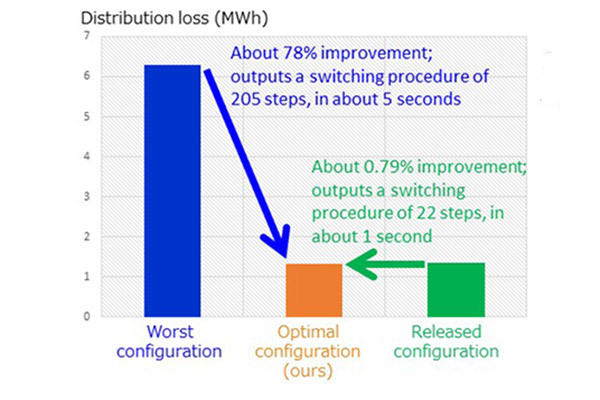
Experiment using a Standard Model of Japanese Power Distribution Networks ⒸTohoku University
Additionally, the cost of wheeling services has attracted attention in Japan due to the upcoming legal separation of power generation and distribution in 2020. A major advantage of our method is that loss improvements can be achieved using existing equipment. Furthermore, our method could help support the operation and management of power distribution systems that are constantly growing more complex due to the spread of distributed generators such as photovoltaic generation systems.

Link:
A benchmark test network of practical scale that was designed based on a real distribution network in Japan. Investigated and published by a research team led by Prof. Yasuhiro Hayashi at Waseda University, Japan. This network contains 468 controllable switch gears, 72 feeders, has a total electricity demand of 73-170MWh, line capacity of 300A, feed voltage of 6.6kV, and voltage operation range of 6.3-6.9kV.
Contact:
For enquiries about the research:
Takehiro ITOGraduate School of Information Sciences, Tohoku University
E-mail: takehiro
 ecei.tohoku.ac.jp
For media enquiries:
Public Relations Office of Graduate School of Information Sciences, Tohoku UniversityE-mail: koho
is.tohoku.ac.jp