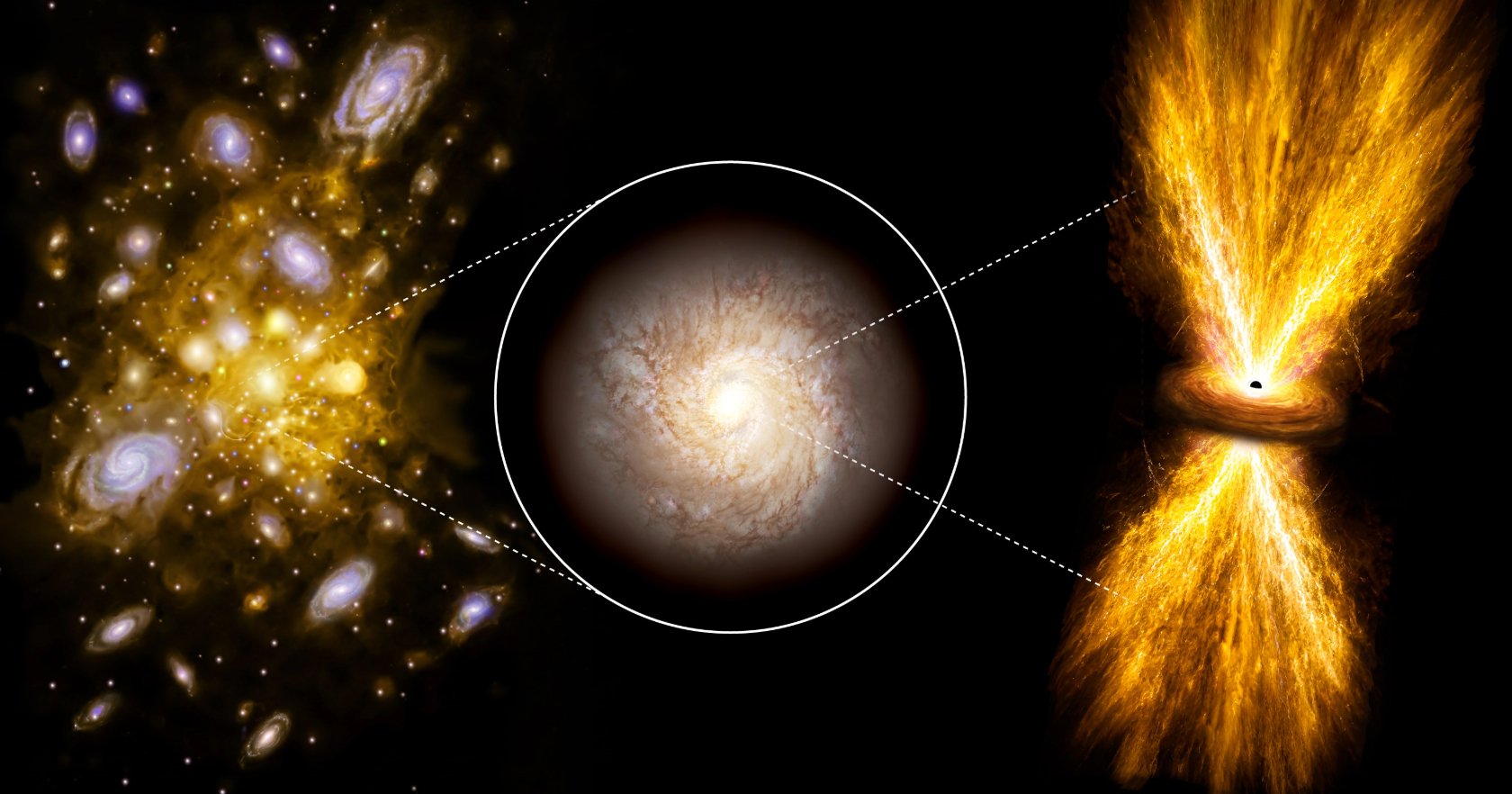
A team of researchers has discovered that the winds generated by supermassive black holes are 100 times more powerful than previously thought, carrying energy across distances of approximately 300,000 light-years. The discovery demonstrates that these explosive winds impact the vast expanse of space beyond the galaxies they inhabit.
"Black holes are largely known for sucking matter in, but they also eject gas in the form of powerful winds," says Satoshi Yamada, Assistant Professor at Tohoku University's Frontier Institute for Interdisciplinary Sciences (FRIS). "These winds were thought to be contained within the galaxy, but our study revealed that the force is immensely more powerful than previously understood."
Yamada and his team, comprising colleagues from Kanazawa University and Tokyo Metropolitan University among others, harnessed the X-ray astronomy satellite XRISM to observe the activity of the quasar H1821+643, which is located in the constellation of Draco, approximately 3.4 billion light-years from Earth. Quasars are extremely luminous objects powered by supermassive black holes that actively consume gas.

The rapidly growing black hole is located at the center of the galaxy cluster, where it drives turbulence in the surrounding hot gas that emits X-rays. The researchers precisely determined the motion of the gas by analyzing the emission lines of iron ions.
High-precision observations by XRISM revealed that the high-temperature gas surrounding the black hole does not remain static, but violently disperses over a wide area due to turbulence. The researchers also confirmed that the flow of gas extends beyond the host galaxy, reaching distances of about 300,000 light-years away. The amount of energy involved in the turbulence was approximately 100 times greater than previous estimates and equivalent to several billion supernova explosions - the explosions that occur when stars reach the end of their lives.

"For the first time, we have shown that black holes influence the broader cosmic environment through a shock wave of astonishing power," adds Yamada. "Black holes are key drivers of gas flows and motion in space, transporting vast amounts of energy to different regions of the cosmos."
Details of the research were published in the journal Nature Astronomy on July 28, 2026.
Future observations are expected to further clarify the effects of black holes on their surrounding environment and how matter and elements circulate throughout the cosmos.

- Publication Details:
Title: Vigorous turbulence driven by quasar-mode feedback in a cluster core
Authors: Satoshi Yamada, Shutaro Ueda, Hirofumi Noda, Yutaka Fujita, Misaki Mizumoto, Kentaro Nagamine, Claudio Ricci, Shoji Ogawa, Taiki Kawamuro, Shinya Yamada, Yuichi Terashima, Yoshihiro Ueda
Journal: Nature Astronomy
Contact:
Satoshi Yamada, (Profile)
Tohoku University / University of Geneva
Email: satoshi.yamadaastr.tohoku.ac.jp
Website: https://www.fris.tohoku.ac.jp/en/researcher/creative/yamada_s.html