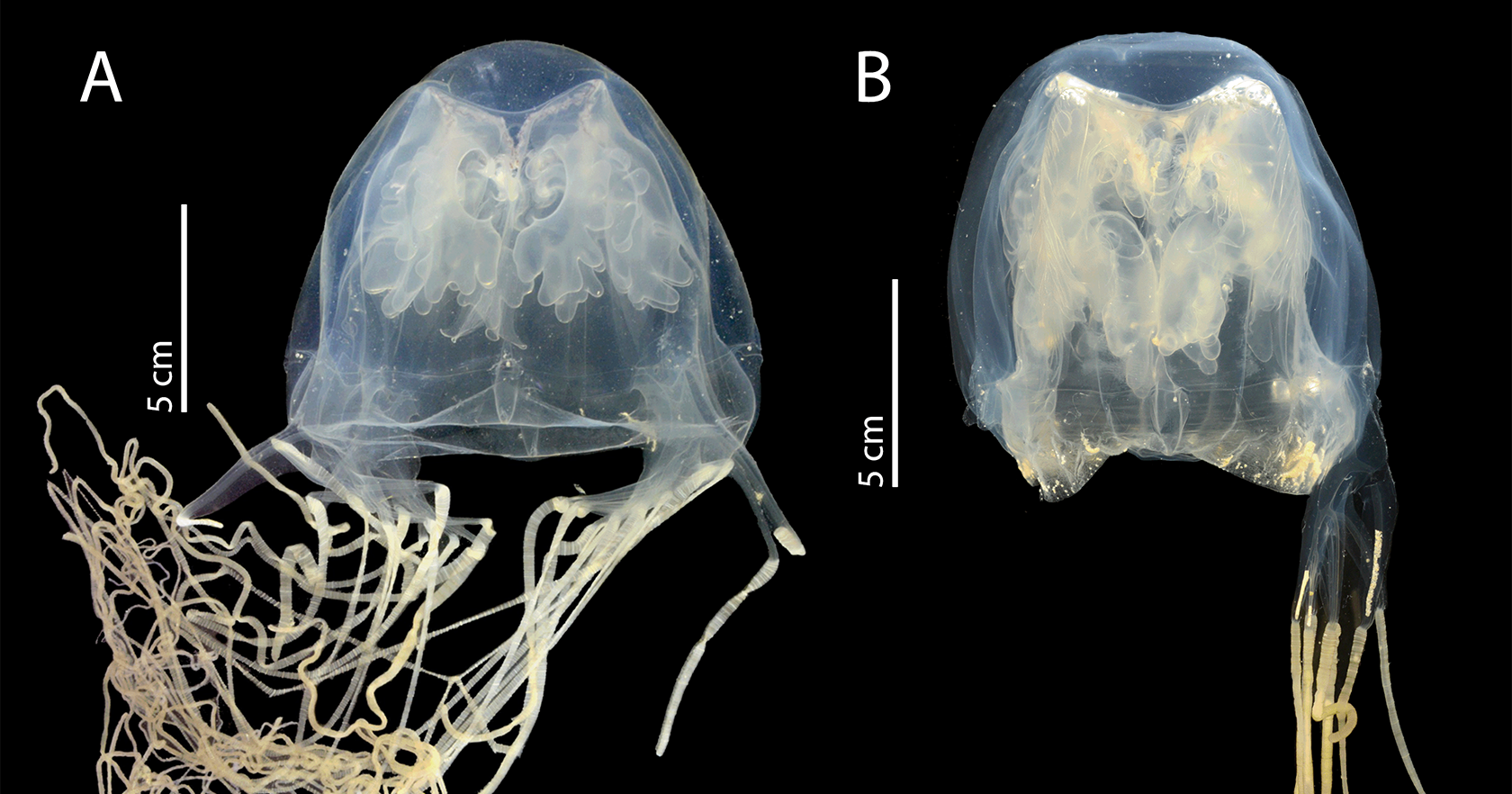
Finding highly venomous box jellyfish that are almost invisible in water is not an easy task - but researching them is crucial so that we can learn how to safely avoid them. Stings from these "sea-wasps" are extremely painful and can be fatal. Knowing more about box jellyfish helps us know where to expect them, when to expect them, and how we can minimize the risk of encountering them while out for what should be a pleasant swim.
Researchers at Tohoku University and the National University of Singapore discovered an entirely new species of box jellyfish: Chironex blakangmati (C. blakangmati). At first glance, it looked similar to others in the Chironex genus, but a thorough genetic analysis confirmed that this is an entirely new species. A detailed morphological analysis corroborates this, as C. blakangmati has unique physical features not seen in other Chironex jellyfish. In addition, they report the first sighting of the Thai sea wasp Chironex indrasaksajiae (C. indrasaksajiae) in Singapore. These exciting discoveries reveal new insights about biodiversity, while also providing an in-depth comparison of all the Chironex species.

The research team collected various Chironex box jellyfish along Singapore's coastal waters of Sentosa Island (historically called "Pulau Blakang Mati" or "Island of Death Behind"), which is how the new species got its ominous name. However, it wasn't clear at first that this was an entirely different species.
"C. blakangmati looks remarkably like Chironex yamaguchii - a jellyfish species I first discovered in Okinawa while doing my master's degree there" explains Cheryl Ames (Tohoku University & WPI-AIMEC). "But we realized they were completely distinct. I actually went back to dust off an old sample of C. yamaguchii I still had in storage in Okinawa to help with the comparisons!"
Until now, the two were assumed to be one species. However, a genetic analysis confirmed this was a case of mistaken identity. Additionally, the research team investigated how to tell the species apart at a glance - allowing for differentiation without having to run a molecular analysis first. The main difference they discovered was located in a part of jellyfish anatomy at the bottom of the bell-shaped body called the perradial lappets, which reinforce the hinged musculature flap that pulsates to propel the box jellyfish as it swims. The three known Chironex species all have pointed canals extending from the tips of the perradial lappets whereas in C. blakangmati, the new species, those canals are absent.
"Our thorough review and analysis of all the Chironex species known to date reveal a lot about these box jellyfishes, and highlight a new, helpful strategy that other researchers can use for species delineation," says Danwei Huang (Lee Kong Chian Natural History Museum, Faculty of Science, National University of Singapore).

In addition to finding a fourth species in the Chironex genus, the researchers also found samples of C. indrasaksajiae. This species is usually seen in Thai waters but was reported in Singapore for the first time in this study. "We were surprised to find C. indrasaksajiae so far away from Thailand," says Ames, "Recording range expansions like these is really important, as we currently know so little about the biodiversity and spatial distribution of box jellyfish."
Unlike most jellyfish that are carried where the current takes them, Chironex have a muscular flap - the same one containing the major clue to telling them apart - and complex eyes that they use to actively swim towards prey. The more we know about the ecological dynamics of this dangerous yet mesmerizing jellyfish, the better we can tailor safety guidelines to protect beachgoers.
The findings were published in Raffles Bulletin of Zoology on May 15, 2026.
This study received funding from WPI-AIMEC and Sasakawa Peace Foundation's Ocean Shot Project.

- Publication Details:
Title: Chironex box jellyfishes (Cnidaria: Cubozoa: Chirodropida) in Singapore: Chironex blakangmati, new species, and range extension of C. indrasaksajiae
Authors: Iffah Iesa, Cheryl Lewis Ames, Nicholas Wei Liang Yap & Danwei Huang
Journal: Raffles Bulletin of Zoology
A pdf version of the paper has also been made available (PDF).
Contact:
Cheryl Lewis Ames
Graduate School of Agricultural Sciences and, Advanced Institute for Marine Ecosystem Change (WPI-AIMEC), Tohoku University & JAMSTEC
Email: ames.cheryl.lynn.a1 tohoku.ac.jp
Website: https://cherylames.com/