
Ammonia (NH3) is essential for fertilizers and emerging carbon-free energy technologies, yet its conventional production via the Haber-Bosch process is energy-intensive and CO2-emitting.
Researchers from Tohoku University and collaborating institutions have established a structural blueprint for deploying 3D COFs in electrocatalysis, opening new routes toward sustainable nitrate management and decentralized ammonia synthesis. The work was published in the Journal of Materials Chemistry A on February 02,2026
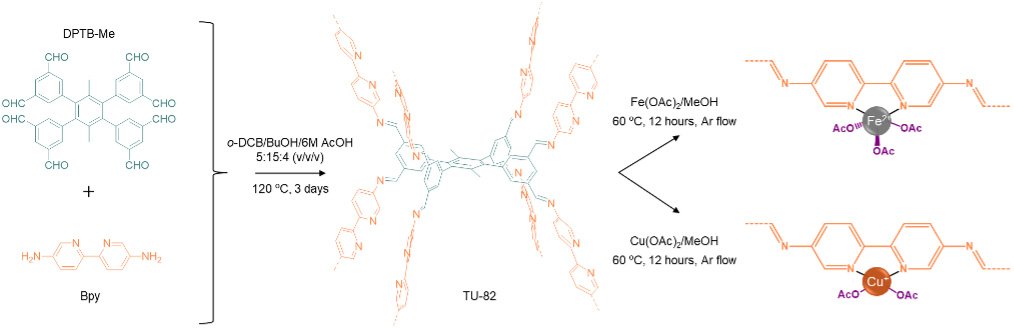
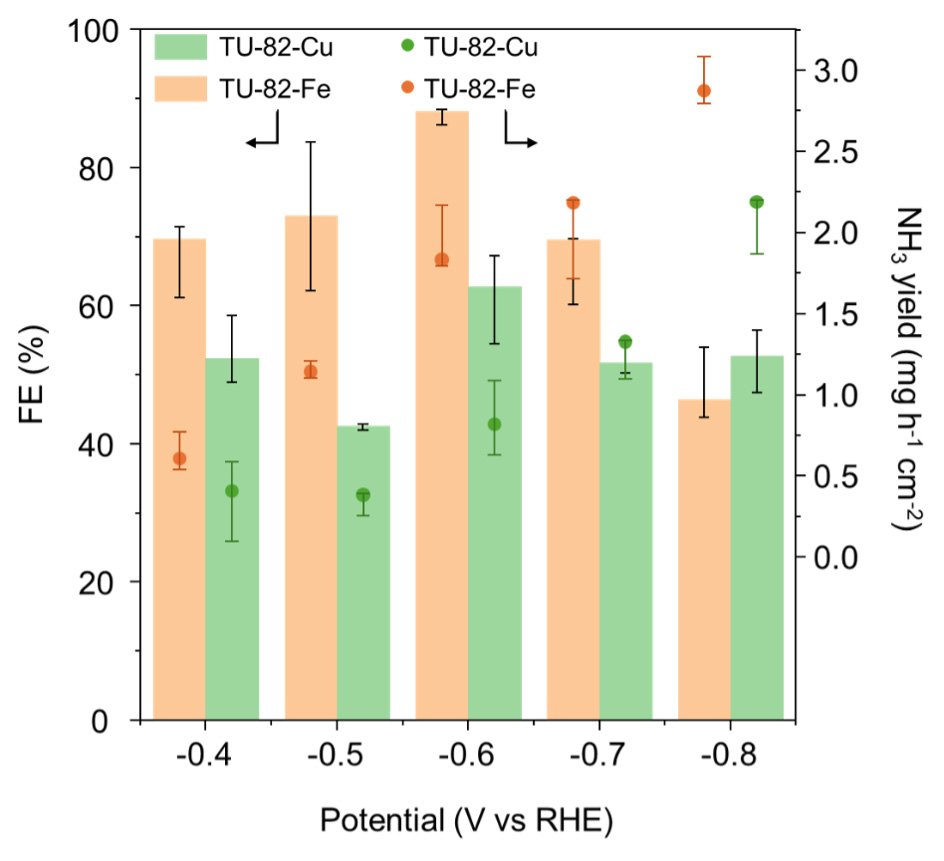
The researchers achieved this breakthrough by developing a topologically intricate three-dimensional covalent organic framework (COF), TU-82, that delivers highly selective electrocatalytic nitrate reduction to ammonia (NO3RR). By precisely metalating bipyridine pockets within a [8+2]-connected bcu network, the team created TU-82-Fe with atomically dispersed Fe active sites, achieving a peak Faradaic efficiency of 88.1% at −0.6 V vs RHE and an ammonia yield rate of 2.87 mg h-1 cm-2 at −0.8 V vs RHE.
Ammonia (NH3) is attracting renewed attention as a next-generation energy carrier because it can be stored and transported more easily than hydrogen and does not emit carbon dioxide when used. However, the dominant Haber-Bosch process relies on high temperature and pressure, and thereby carries a substantial carbon footprint.
An emerging alternative is electrochemical nitrate reduction to ammonia (NO3RR), which can operate at ambient conditions and simultaneously mitigates nitrate contamination by transforming NO3− into a valuable chemical. Realizing this vision requires catalysts that combine high activity, selectivity, and stability while suppressing competing hydrogen evolution.
Covalent organic frameworks (COFs) are crystalline, porous polymers whose modular structures can host well-defined catalytic sites. Yet, most COF electrocatalysts reported for NO3RR are two-dimensional, where interlayer stacking can limit mass transport and site accessibility. Three-dimensional COFs, by contrast, offer isotropic diffusion pathways and higher structural robustness―an opportunity that has remained largely untapped for NO3RR.
"By integrating precise topological design with site-specific metal coordination, we can create a truly three-dimensional, porous scaffold that exposes uniform catalytic centers for nitrate-to-ammonia conversion," explains Dr. Saikat Das (Junior Associate Professor, Institute of Multidisciplinary Research for Advanced Materials, Tohoku University).
The team synthesized TU-82 via Schiff-base condensation to form a highly ordered 3D network containing bipyridine units. These bipyridine pockets enable controlled postsynthetic coordination of metal ions, yielding TU-82-Fe and TU-82-Cu without disrupting the underlying framework crystallinity and porosity.
Electrochemical evaluation in alkaline nitrate electrolyte showed that TU-82-Fe outperforms its Cu analogue, delivering a maximum Faradaic efficiency for NH3 of 88.1% at −0.6 V vs RHE and reaching 2.87 mg h-1 cm-2NH3 yield at −0.8 V vs RHE, alongside excellent operational durability. Density functional theory calculations further reveal that the superior activity of TU-82-Fe arises from a lower energy barrier (0.354 eV) for the rate-determining NO*→NHO* step along the NHO-mediated pathway.
"This study shows how three-dimensional reticular design can be used to program catalytic microenvironments and unlock high-performance nitrate-to-ammonia electrosynthesis," remarks Yuichi Negishi (Institute of Multidisciplinary Research for Advanced Materials). "We anticipate 3D COFs will become a powerful platform for sustainable nitrogen-cycle electrocatalysis."

- Publication Details:
Title: Efficient ammonia synthesis via electrocatalytic nitrate reduction over a [8+2]-connected three-dimensional metal-bipyridine covalent organic framework
Authors: Tsukasa Irie, Ayumu Kondo, Kai Sun, Kohki Sasaki, Mika Nozaki, Shiho Tomihari, Kotaro Sato, Tokuhisa Kawawaki, Yu Zhao, Saikat Das and Yuichi Negishi
Journal: Journal of Materials Chemistry A
DOI: 10.1039/D5TA07989F

Contact:
Yuichi Negishi
Institute of Multidisciplinary Research for Advanced Materials
Email: yuichi.negishi.a8 tohoku.ac.jp
Website: https://www2.tagen.tohoku.ac.jp/lab/negishi/html/index.html