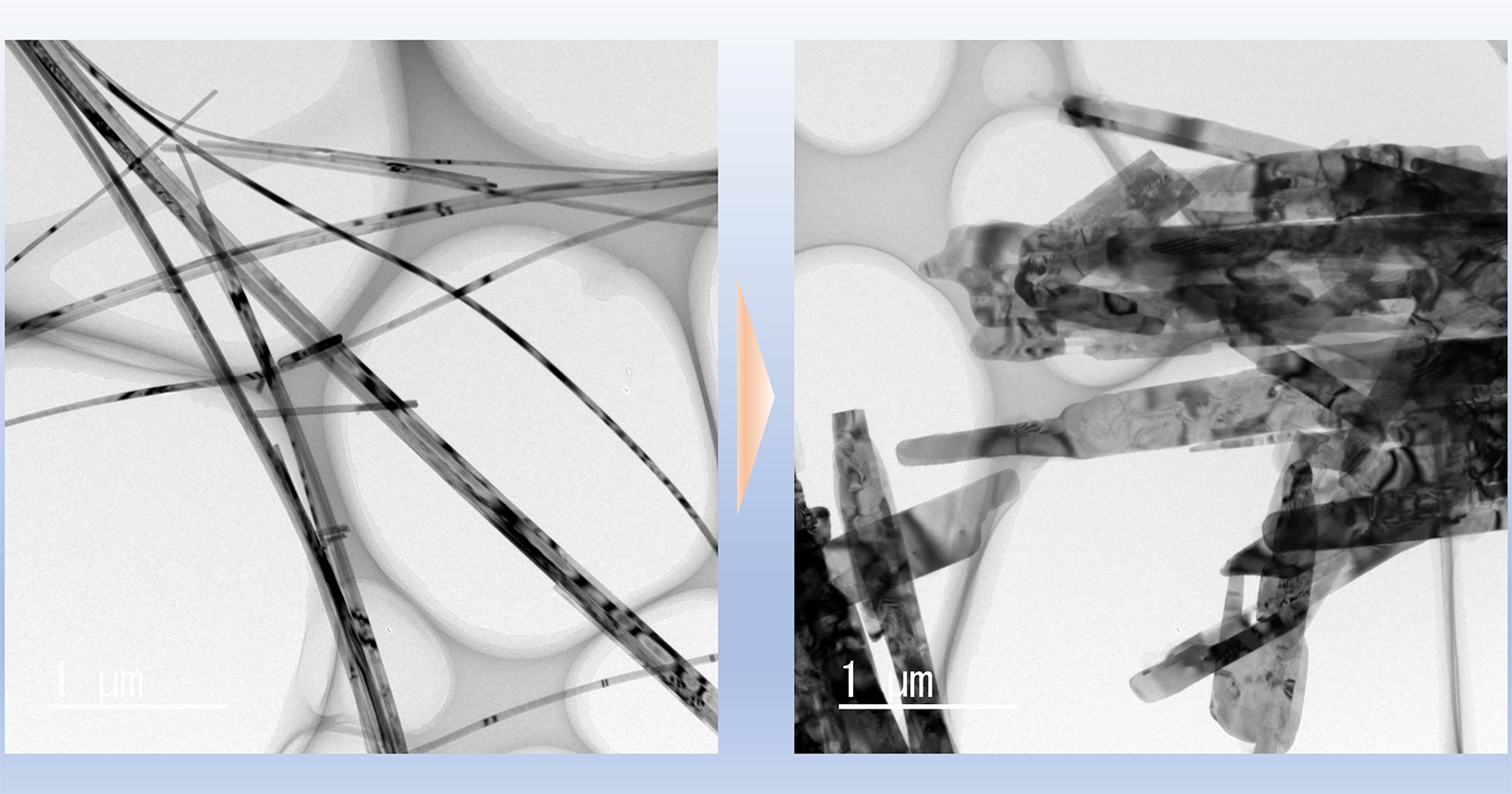
An international research team has successfully synthesized oriented belt-shaped vanadium dioxide (VO2(B)) single crystals via a hydrothermal reduction method, using one-dimensional vanadium pentoxide (V2O5) nanofibers as the starting material. This work provides a new material platform and design guidelines for the development of next-generation low-power gas sensors capable of operating at room temperature.
Their research is published in the journal ACS Sensors on February 16, 2026.

Volatile organic compounds (VOCs) emitted from industrial activities and vehicle exhaust are major urban air pollutants. Because VOCs pose serious environmental and health risks, developing effective monitoring for them is a global concern. Gas sensors can monitor for VOCs, but it has been a major challenge for scientists to develop sensors that work reliably at room-temperature. Currently, metal oxide semiconductor gas sensors operate at 200-400 °C.
"This heating requirement greatly increases power consumption and limits their use in portable devices, battery-powered systems, and large-scale Internet of Things sensor networks," said Professor Shu Yin from the Institute of Multidisciplinary Research for Advanced Materials (IMRAM), Tohoku University (also affiliated with the Advanced Institute for Materials Research, WPI-AIMR).
The research team used one-dimensional V2O5 nanofibers as the starting material and successfully synthesized belt-shaped VO2(B) single crystals through a hydrothermal reduction method. Then they tested the VO2(B) crystals' sensitivity to ethanol.
"Compared with the original material, the synthesized VO2(B) crystals exhibited approximately 19 times higher sensitivity to ethanol at room temperature. In addition, their selectivity toward ethanol over other gases was significantly improved," said Yin.
To better understand the synthesized VO2(B) material's excellent selectivity, the team used density functional theory (DFT) calculations. These calculations revealed for the first time that the unique surface structure of VO2(B) strongly adsorbs ethanol molecules and promotes efficient charge transfer. This helped them clarify the mechanism responsible for the enhanced sensing performance.

Unlike traditional vanadium oxide materials such as V2O5, the single-crystal VO2(B) demonstrates strong potential for high-performance gas detection at room temperature. By clarifying the exceptional room-temperature sensing properties of single-crystal belt-like VO2(B), this study opens a new pathway toward next-generation, low-power, high-performance VOC sensors that help us detect harmful gases.
"This advancement could enable more energy-efficient air quality monitoring systems, safer industrial workplaces, and compact sensing devices integrated into smart infrastructure. Ultimately, it contributes to improved environmental protection, public health, and everyday safety," said Yin.

- Publication Details:
Title: Superior Room-Temperature Gas Sensing Performance of Belt-like VO2(B) over 1D V2O5 Nanofibers
Authors: Qiuyu Cheng, Lei Miao, Peng Song, Qiuyu Jin, Ayahisa Okawa, Takuya Hasegawa, Kenta Hongo, Fu Tang, Wenbin Cao, Te-Wei Chiu, Tohru Sekino, Shu Yin
Journal: ACS Sensors

Contact:
Professor Shu Yin
Institute of Multidisciplinary Research for Advanced Materials (IMRAM),
Advanced Institute for Materials Research (WPI-AIMR),
Tohoku University
Email: yin.shu.b5 tohoku.ac.jp
Website: https://www2.tagen.tohoku.ac.jp/en/