
Silicon carbide (SiC) is a ceramic known for its excellent heat resistance and chemical stability, which makes it attractive for a wide range of applications like electronics, catalysts, and energy-related materials. However, SiC generally requires high-temperature processing, and simultaneously forming and controlling porous structures at the nanometer scale remains challenging.
A research team led by the Institute for Materials Research (IMR) at Tohoku University has found an innovative way to minimize this challenge. The team successfully formed crystalline β-SiC at just 800°C, substantially lower than the temperatures typically used to produce nanostructured SiC. Remarkably, the process simultaneously created a distinctive porous architecture made of nanoscale plates interconnected in three dimensions.
The researchers developed a new route to nanoporous β-SiC using liquid metal dealloying (LMD). LMD works by immersing a solid precursor containing multiple elements in a molten metal, which selectively removes a specific element. In this study, the researchers used Mn5SiC, a compound with a layered crystal structure, as the precursor and immersed it in molten bismuth. Manganese was selectively dissolved into the molten metal, while the remaining silicon-carbon framework reorganized to form crystalline β-SiC.
"LMD is a method that has been previously applied mainly to metals, intermetallic compounds, and semimetals, but our research expands the scope to strongly covalently bonded ceramics," says Hidemi Kato, professor at the Institute for Materials Research, Tohoku University. "We think this approach could provide an exciting new strategy for designing nanoporous ceramics."
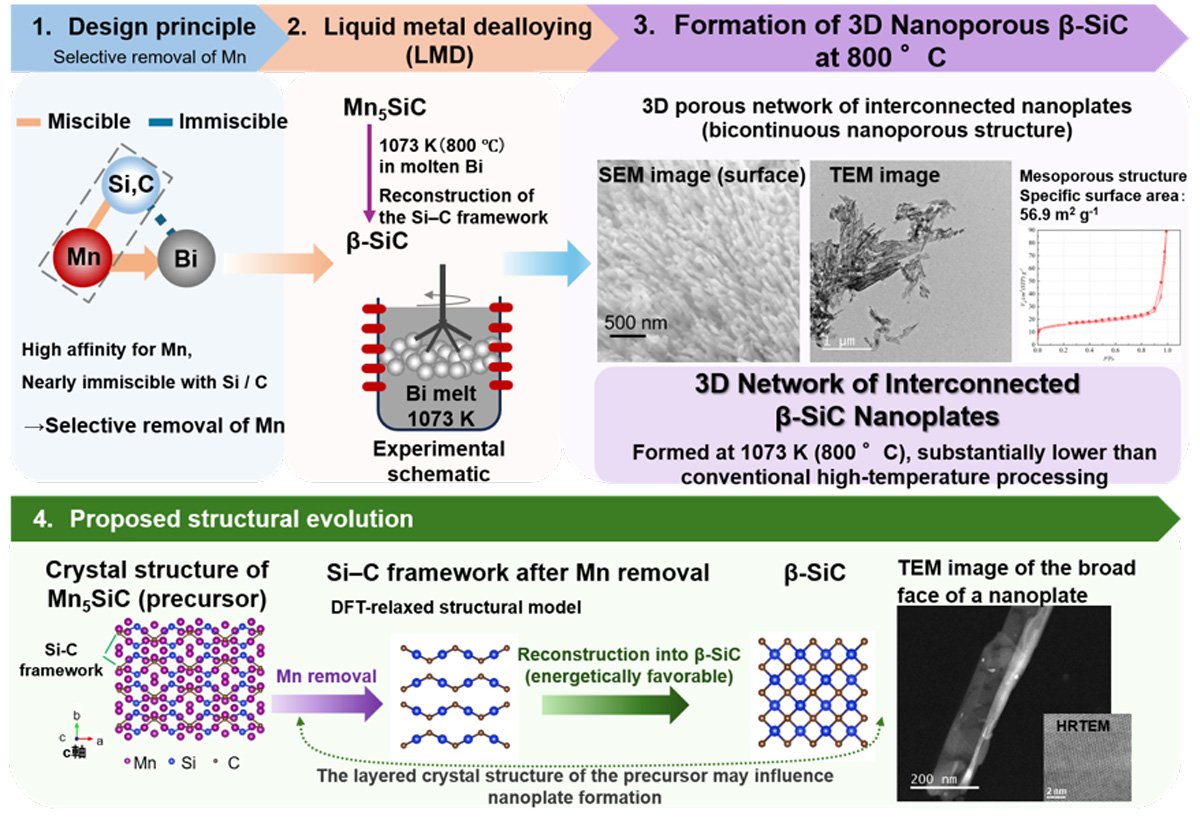
First-principles calculations indicated that the structural rearrangement of the remaining silicon-carbon framework into β-SiC is energetically favorable. The researchers also suggest that the layered crystal structure of the precursor may have influenced the formation of the nanoplate architecture. Further studies will be needed to clarify how the precursor structure is related to the growth and crystallographic orientation of the nanoplates.
The study demonstrates that crystalline nanoporous β-SiC can be formed at relatively low temperatures while simultaneously creating a three-dimensional nanoscale porous architecture. This provides a new route for making and structurally controlling covalently bonded ceramics under milder thermal conditions than conventional methods.
The findings were published in Scripta Materialia on September 4, 2026.
- Publication Details:
Title: Liquid Metal Dealloying Enables Low-Temperature Synthesis of Nanoporous β-SiC with an Interconnected Nanoplate Network
Authors: Xiao Bian, Takeshi Wada, Hongyi Li, Ruirui Song, Mikihisa Fukuda, Nana Murata, Tetsu Ichitsubo, Hidemi Kato
Journal: Scripta Materialia

Contact:
Hidemi Kato
Institute for Materials Research
Email: hidemi.kato.b7 tohoku.ac.jp
Website: https://www.nem2.imr.tohoku.ac.jp/index.html