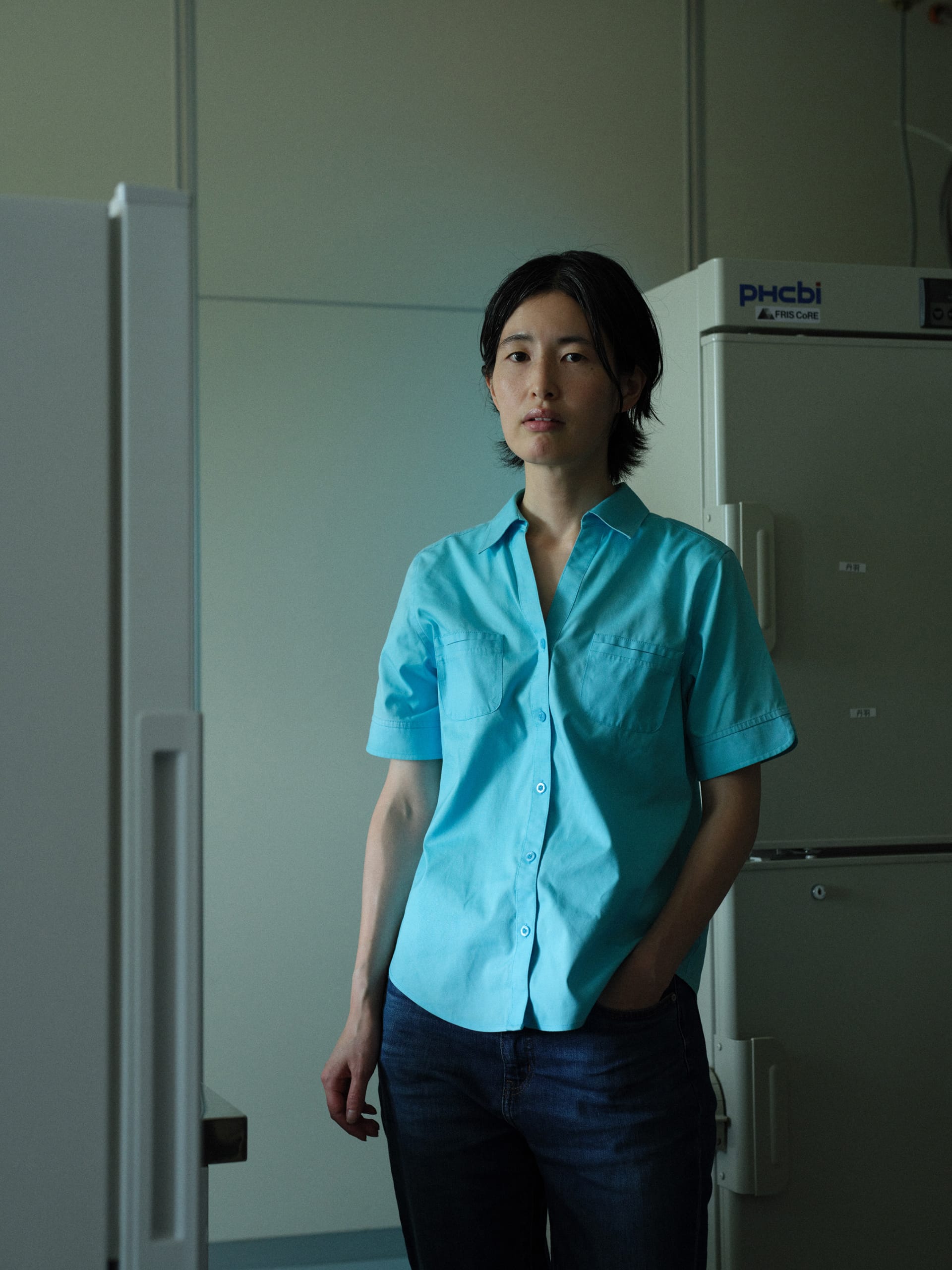
The
Romance
of
Research
Kyoko
Chiba
Assistant Professor,
Frontier Research Institute
for Interdisciplinary Sciences (FRIS),
Tohoku University
Field of Specialty:
Biochemistry
Specific Topics:
Mechanism of motor protein activation,
cargo binding mechanism of motor
proteins, and the association between
neurodegenerative diseases and
abnormal intracellular transport

The Beauty
of Intracellular Transport
The graceful, almost poetic movement of proteins inspired a deep curiosity inside of me to learn more
What inspired you to start studying intracellular transport?
I was originally interested in human disease, specifically Alzheimer’s disease. Whilst researching in a laboratory, I learned about the amyloid precursor protein, or APP, which is closely linked to the disease. What fascinated me was that APP is actively transported inside neurons. Proteins that move in this way are not very common, and when I observed this movement under the microscope, the beauty of the process struck me, sparking an interest in how proteins move inside cells and how that transport is regulated. Therefore, I decided to study abroad, choosing a laboratory where I could explore motor proteins in more depth. At UC Davis, I learned new and exciting techniques to analyze motor proteins in greater detail.
How do problems with motor proteins affect our everyday health?
Motor proteins transport many essential components inside our cells, such as mitochondria and synaptic vesicles, which are crucial for neuronal function. If motor proteins do not work properly, intracellular transport is disrupted, which has been linked to neurodegenerative diseases such as Alzheimer’s disease, dementia, or ALS. Cells rely on precise transport systems to function normally, and disruptions to these systems can have serious consequences for our health.
Could you elaborate a little more on the transportation system?
APP, for example, is transported by the motor protein kinesin, which grabs APP and carries it along cellular structures. Kinesin has two legs, allowing it to walk step by step along microtubules. When I first watched this process unfold, the graceful, almost poetic movement of proteins inspired a deep curiosity inside of me to learn more. Hence why I have shifted from studying Alzheimer's to the transport system itself. Motor proteins are like the delivery drivers who deliver hundreds of packages across town. They come to the sorting depot to collect the cargo, and then transport it to its destination.
That sounds fascinating. So these kinesins are constantly moving across our cellular structures?
Actually, no. Normally, the vast majority of our kinesin remains auto-inhibited. They have built-in brakes to stop them from moving. Like taxi drivers waiting at a station for passengers, the kinesin awaits only for the cargo that needs transporting. This “brake-locked” state is crucial for healthy intracellular transport. In some disease states, the brakes begin to fail. Constant activity can overload neurons, waste energy, and ultimately damage the nervous system. This was a principal finding of my research. Previously, disease mutations were associated with reduced motor protein activity. My discovery observed that increased activity can also be detrimental, causing the motor proteins to overwork. Hard work is not always a positive.
Wow. So healthy kinesin is crucial for a healthy cellular system. Does it have any other roles?
It is even crucial to making sure the nucleus of the cell stays in place, essentially anchoring it in place. Without kinesin, the nucleus can drift away from its proper position, which would be detrimental to normal cellular function.
The position of the nucleus is tightly linked to how a cell works and how a tissue is organized. If the nucleus is misplaced, it can interfere with cell division and cell movement. It can also disrupt proper differentiation of cells into specialized types, such as muscle or nerve cells. Over time, this misalignment can compromise the overall structure and health of an organism.
Image courtesy of Tohoku University and Studio Xxingham

Image courtesy of Tohoku University and Studio Xxingham
And how do you observe this process?
While at UC Davis, I learned a technique called single-molecule observation, which I have since gone on to apply in my research. This allows us to directly watch individual motor proteins moving along microtubules. In this setup, only the motor proteins and microtubules are present, without interference from other cellular components. This is extremely important because it allows us to clearly determine whether changes in motor protein behavior—such as a broken brake mechanism—are intrinsic to the protein itself. Without this technique, it would be difficult to draw firm conclusions about how motor proteins behave in disease. It is a very pure experimental system.
FRIS is known for its interdisciplinary environment. But what challenges do you face when conducting interdisciplinary research?
Many researchers who collaborate are great at explaining their research in an easy-to-understand manner. But in order to carry out impactful interdisciplinary research, we must go beyond surface-level understanding of each other's research. We need to truly grasp the fundamental mechanics behind our colleagues' research, which is not always easy. Especially when factoring in time constraints.
What keeps you motivated when you face setbacks or experimental failures?
Sometimes the best approach is stepping away. When reaching a stumbling block, I will take a break or go home, and return to the experiment another day. Stepping away allows me to reset and often leads to greater clarity. But research is full of difficulties and setbacks. My advice to those engaging in research is simple: do not give up. Even when things are hard or experiments fail, perseverance is essential.
What do you enjoy doing in your free time?
In my free time, I enjoy running and going for walks. These activities help me refresh my mind, step away from the laboratory, and regain focus when I return to my research.
Photograph: A bag full of microtubes, essential tools used daily for storing biological samples in the laboratory
Kyoko Chiba is an Assistant Professor at the Frontier Research Institute for Interdisciplinary Sciences, specializing in biochemistry and intracellular transport. Her work centers on the molecular mechanisms that regulate motor proteins—essential biological machines responsible for transporting cargo within cells.
More specifically, she focuses on how motor proteins are activated and how they bind to cargo, with particular attention to their normally inactive “brake-locked” state that prevents unnecessary energy consumption. Using single-molecule observation techniques, she directly visualizes the behavior of individual protein molecules to uncover how cargo binding triggers motor activation. Because mutations in motor protein genes are closely linked to neurodegenerative and other human diseases, her work aims to clarify how abnormalities in intracellular transport contribute to disease pathogenesis, ultimately supporting the development of future therapeutic strategies

Romance
of
Research