The
Romance
of
Research
Yuji
Saito
Associate Professor,
Graduate School of Engineering,
Tohoku University
(At the time of the interview:
Associate Professor,
Frontier Research Institute
for Interdisciplinary Sciences (FRIS))
Field of Specialty:
Space propulsion engineering
Specific Topics:
Hybrid thrusters and combustion

Rocket Man
No one has tried this before – not even NASA or JAXA. Tohoku University will be the first.
Can you briefly tell me about your research?
My research focuses on space exploration and rocket propulsion. I study combustion, which is an oxidation reaction that fuel undergoes to be converted into energy that can propel rockets.
How did you first become interested in this field of research?
It started simply by looking upwards. I was interested in the weather at first, then my interests kept getting further and further away from Earth until I ended up in outer space! (laughs) I became fixated on this end goal of somehow contributing to space travel and exploration. This fixation is how I started on my path. It is immensely rewarding to conduct research where I can easily see the impact of my work, such as creating thrusters that are bound for outer space.
How did your industry collaboration with ElevationSpace come to be?
The co-founder, Professor Kuwahara, approached me asking to collaborate on developing a thruster in 2021. However, this was during the peak of the COVID-19 pandemic, so everything was completely remote. I remember having online meetings every Friday night and not finishing until sunrise on Saturday morning. This was a true passion project, so we had to find time to develop it outside of our usual university work.
Wow, that is true dedication! Can you tell us more about the thruster you developed together?
A solid rocket uses solid fuel and a solid oxidizer. A liquid rocket uses liquid fuel and a liquid oxidizer. However, we use a hybrid thruster that uses a mixture of solid fuel and a gas or liquid oxidizer. The solid fuel is made of, essentially, the same material as plastic bags, so it’s very safe and easy to obtain.
Hybrid thrusters are still a very new type of technology, so this kind of rocket has never been sent to space before. I am very proud that next year, our hybrid thruster will be the first to go to space. No one has tried this before – not even NASA or JAXA. Tohoku University will be the first. Our tests so far have been successful, so we are very excited to see our rocket in action!
What was the development process like?
It was a challenge. Since this is a world first, we have no references to guide us. The main issue for development is thermal isolation, which is something hybrid rockets tend to have issues with. The combustion temperature is a blistering 3000 Kelvin (over 2700 Celsius), so we must protect the combustion chamber itself to prevent melting. It becomes a balancing act as we have to add reinforcements to protect the chamber without saddling on so much extra weight that it becomes too heavy to fly.
Image courtesy of Tohoku University and Studio Xxingham

Image courtesy of Tohoku University and Studio Xxingham
FRIS has a rather unique organizational structure. Can you tell me more about it?
Yes, the structure at FRIS very closely follows the research goals set by the University for International Research Excellence (UREX) guidelines, in that different divisions aren’t siloed away. My room in FRIS is next to astronomy, materials science, and engineering labs, so inter-disciplinary collaborations are just a few steps away.
In addition, FRIS differs from the typical Japanese system where a senior researcher makes decisions for their entire lab group. I am 33 years old, which is considered quite young in academia. Despite this, I am already a Principal Investigator (PI) of my own lab at FRIS. This means I can decide what I want to research and what projects to pursue. Each PI has the freedom to take on research that specifically interests them, allowing their unique research skills to really shine.
What do you like to do to relax in your free time?
I love baseball. I was a pitcher, but I broke my shoulder in high school, so I switched to softball (two-time participant in the National Sports Festival of Japan). I also love watching Koshien (Japanese high school baseball). I have a young daughter, and I want to teach her softball when she’s older, but my wife is worried about her being out in the sun all the time (laughs).
Photograph: Rocket fuel after firing. The fuel and rocket designs were determined based on the results of several firing tests.
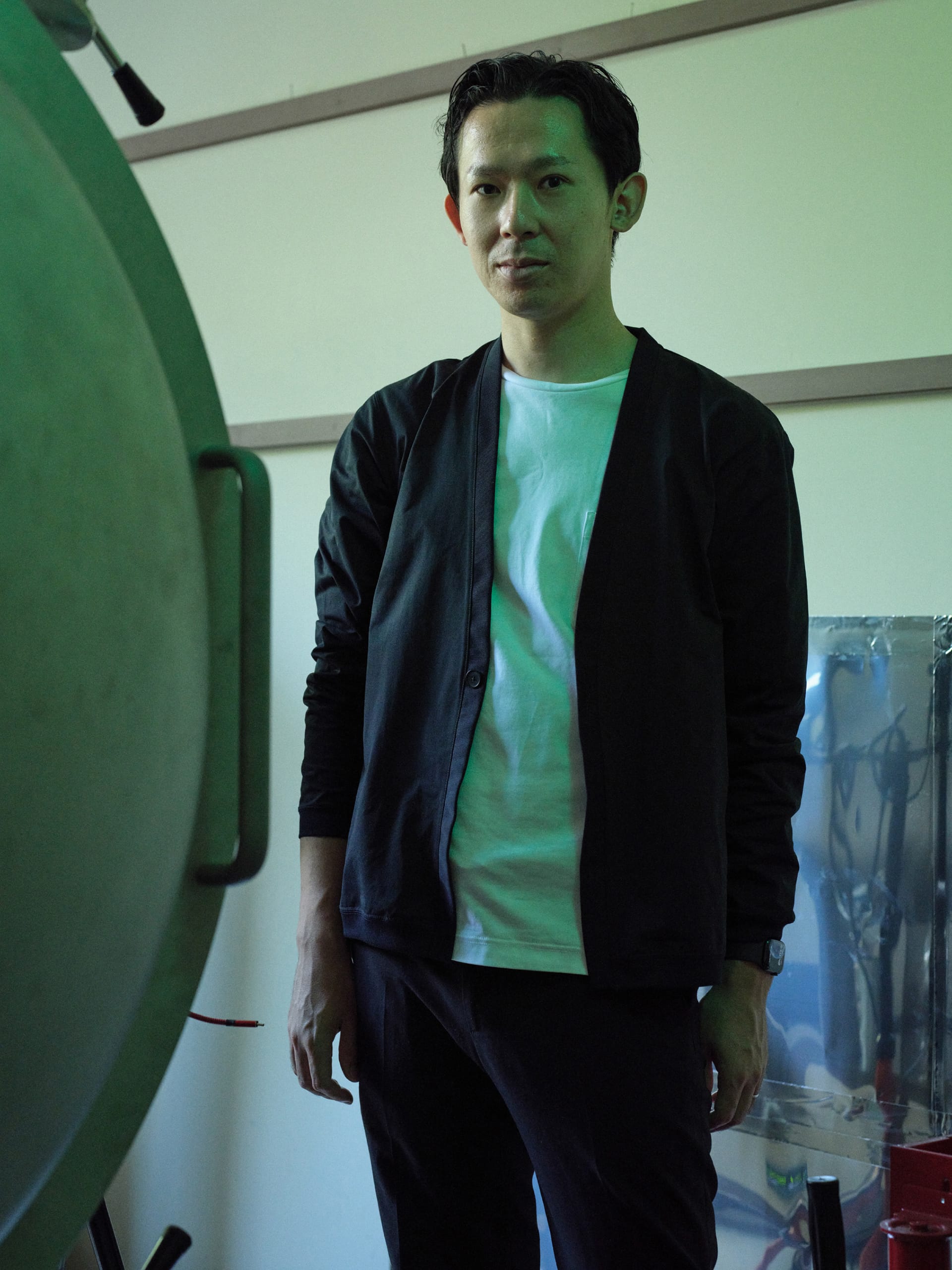
Yuji Saito has always been looking up at the sky. First, at the clouds and weather patterns directly above, then higher and higher as the vastness of outer space captured his heart. Driven by his aspiration to contribute to space exploration, he completed both his undergraduate and graduate studies in engineering at Hokkaido University. In 2021, at age 29, he joined Tohoku University at the Frontier Research Institute for Interdisciplinary Sciences (FRIS), and in April 2026 took up his current post as Associate Professor at the Graduate School of Engineering. Since January 2026, he has also concurrently served as the Director of the Advanced Space Propulsion Technology Research Division at the Research Center for Space Cross-Tech, Green Goals Initiative. He is now responsible for his own research projects, focusing on the internal ballistics of rockets and the development of propulsion systems. His lab’s research boasts strong real-world applications for space exploration, while building upon basic science as a strong foundation. He has many industrial collaborations – such as his work preparing the first hybrid thruster demonstration in space with ElevationSpace - and files multiple patents while publishing peer-reviewed journal papers each year. With growing ambitions fueled by a keen curiosity, this young researcher is just starting to take off.

Romance
of
Research