
Documenting Languages at Risk
We usually think of language as a communication tool, but every language reflects the long history of a community of people.
Tell me briefly about your research.
I have been researching an unwritten and unstudied language called Tutuba, spoken in the Republic of Vanuatu. It has only 500 speakers and is endangered. I have published a descriptive grammar of this language and a Tutuba-Bislama-English dictionary with some linguistic papers.
What attracted you to this field?
I became interested when my instructor at university said that there are so many languages in the world and some are disappearing without being documented because they have no writing systems. I also noticed the research disparity between majority and minority languages, which further inspired me to learn more about endangered languages.
There seems to be a strong cultural element in your work. Do you consider yourself a linguist or an anthropologist?
Definitely a linguist! My research method has anthropological elements because when there is no accommodation on the island, I have to stay with locals and learn their language through daily contact and assimilation. Sometimes when linguistic logic is difficult to apply, anthropological or sociolinguistic approaches are useful to explain various situations. But my primary interest is linguistics.
How much is lost when languages become extinct?
We usually think of language as a communication tool, but every language reflects the long history of a community of people. Languages tell us how people moved across the world from Africa, and they contain unique expressions that embody history, culture and ancestral wisdom. So, we lose a bit of valuable human history when a language disappears.
How did you begin researching something that had almost no existing resources?
Initially I tried the internet and books but didn’t find any useful information, so I decided that going to Vanuatu myself would be the best way to get information. I realized that I needed to learn Bislama, the national language of Vanuatu, to communicate with vernacular speakers, so I stayed in the dormitory at the University of the South Pacific for a month and went to the market every day to hear people speaking Bislama. I took notes, tried to describe what I heard, and practiced using Bislama daily. Then in my first year as a master’s student, I returned to Vanuatu and went into the jungle to learn what language the indigenous villagers spoke. I also visited a small island by boat. That’s how I first came across Tutuba.
Image courtesy of Tohoku University and Studio Xxingham

Image courtesy of Tohoku University and Studio Xxingham
Did you have a guide in the jungle?
No, I went by myself. I was about 23 years old. Of course I was a little afraid, but I think I was more excited. Until then, all my textbooks contained information that other people had discovered or researched. I never imagined that there were things nobody had studied yet, spaces where I could do original research. So, this was very exciting to me.
What challenges did you face during your field work?
I was always alone and had to decide everything by myself with almost no knowledge or information to support my decisions. I had no idea who I could trust or rely on. Every decision was critical because if I made the wrong choice, there could be serious risks and consequences. I had to navigate jungles and travel between islands by boat with no rescue systems in place. I could have died without anyone knowing, and that was something I was aware of. But most of the time, the excitement and fascination of exploring new things helped me overcome my fears.
You did in fact have a close brush with death, didn’t you?
Yes, I got plasmodium falciparum malaria and dengue fever at the same time. I was in the jungle and felt that something was wrong, so I made my way to a clinic in the city and the nurse with extensive experience working in doctorless regions warned me I would die within a week if this continued. I was quite young - a second-year master's student at that time - and I was so shocked that I wrote a will.
What were your end goals when you started this research?
I wanted to make a dictionary and grammar book to try to preserve the Tutuba language, or at least to record the crystallized wisdom embodied in the knowledge that lives on in a remote region. At the same time, I was mindful of the need to faithfully document primary data from an endangered language, to contribute to the future development of linguistic research.
Are you working on new research now?
Yes, I've largely completed my work on Tutuba, so I'm expanding my goals to study other under-researched countries and territories in Oceania such as Kiribati, Nauru, Fiji and the Solomon Islands. This summer, I started my new research on the language of Kiribati, where the rising sea level is making their land area smaller. If people there are forced to move, their language could soon be in danger of being lost.
In your research to learn about other people and other languages, what have you learnt about yourself?
Although I encountered a series of unpredictable events and challenges, I came to realize that I have a persistent side that strives to understand situations carefully. I believe that where there’s a will, there is a way, so I try to always have a positive approach to research and to life.
Photograph: Two decades of fieldwork in Vanuatu, observations and research data are meticulously recorded by hand in over a hundred notebooks.
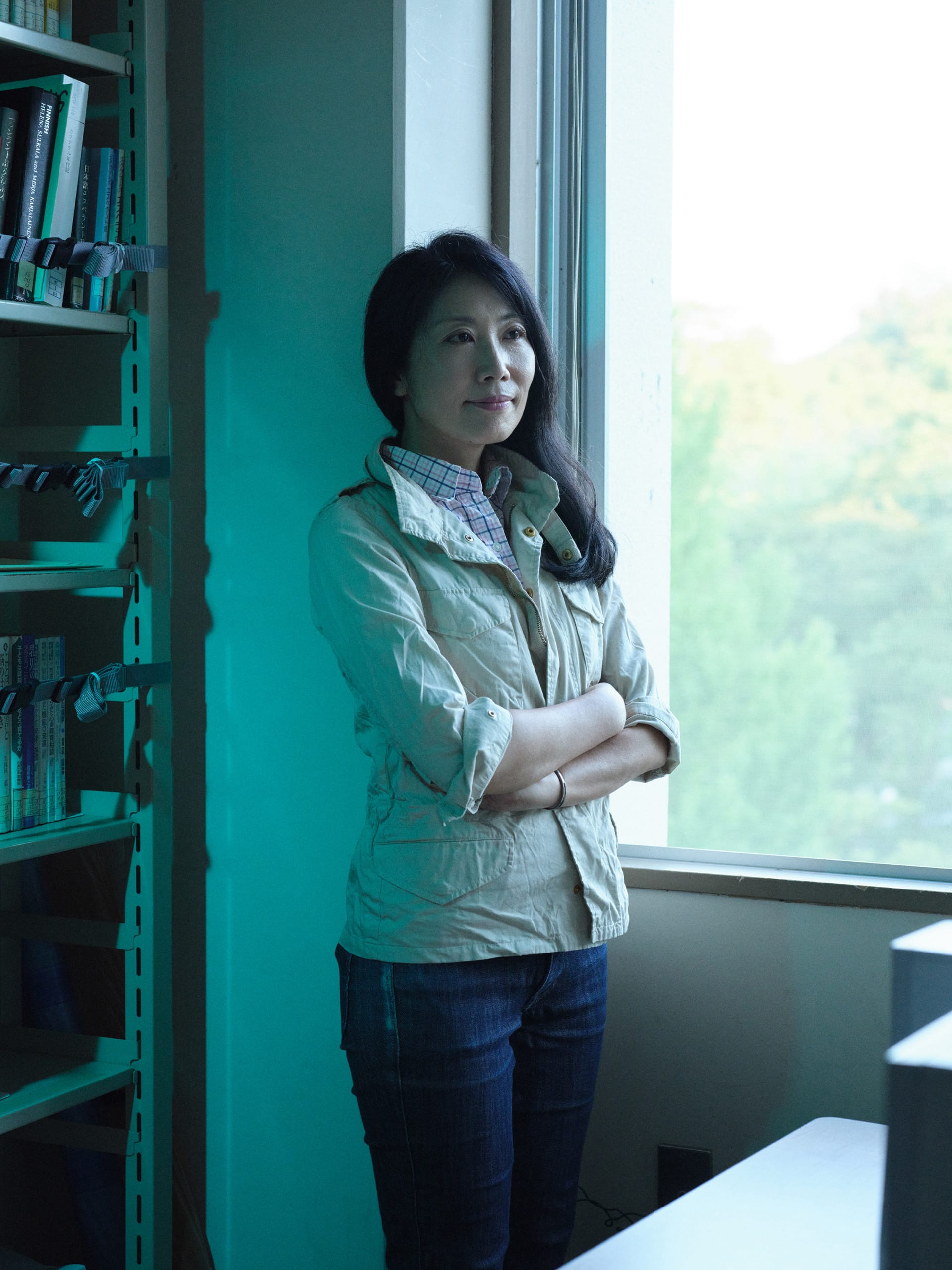
From an early age, Maho Naito enjoyed reading adventure stories and mystery novels, and later found herself embarking on real-life adventures as a researcher. She first visited the Republic of Vanuatu - an archipelago in the South Pacific Ocean comprising 83 islands – as a fourth-year undergraduate at Tokyo Woman’s Christian University. In over two decades of studying Vanuatu’s Indigenous peoples and the Tutuba language, she amassed more than a hundred notebooks of handwritten observations and research data.
Naito joined Tohoku University’s Graduate School of Arts and Letters in 2021 as an associate professor. In 2025, she received the university’s Murasaki Sendai Hagi Award, which honors outstanding female researchers for their contributions to diversity, equity and inclusion on campus and beyond.

Romance
of
Research