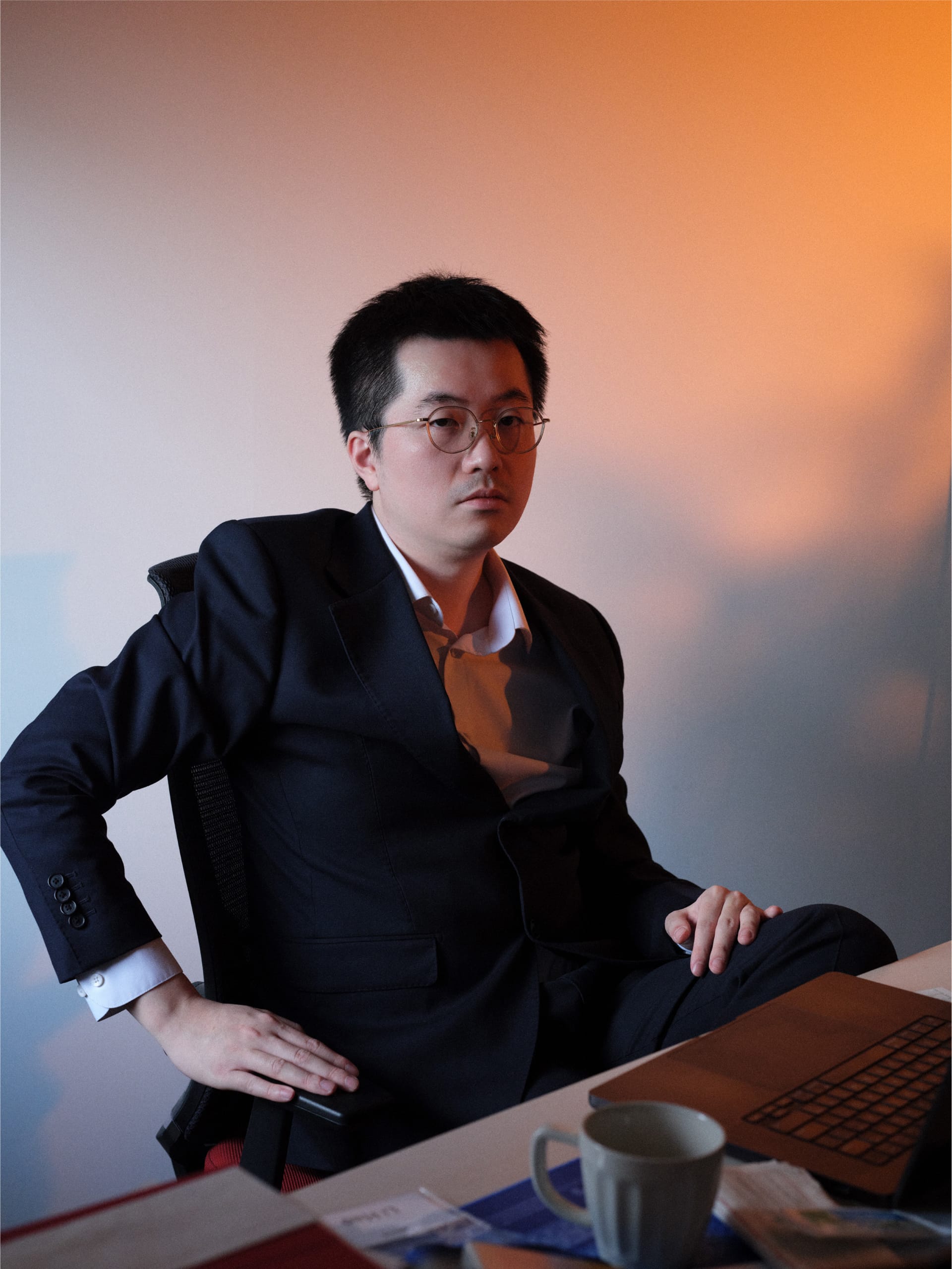
The
Romance
of
Research
Hao
Li
Distinguished Professor,
Advanced Institute for Materials Research
(WPI-AIMR),
Tohoku University
Field of Specialty:
Materials science
Specific Topics:
Catalysis and materials theory
Data science for materials design
Computational methodology
development based
upon artificial
intelligence
"e-Refinery” for sustainable production

Changing
the World,
One Material
at a Time
Climate change, high energy costs and demand, and a lack of food and clean water require urgent action, and we need to accelerate the discovery of new, industrially important materials to combat these problems.
What sparked your interest in materials science?
The answer is simple: materials science can change the world. To tackle climate change, we need to discover new materials that help make engineering more economical and less polluting. New catalysts, batteries, and hydrogen storage materials lay the pathway to a greener, brighter, and cleaner future. I want to play my part in building this future.
Much of your research involves finding new catalysts. Why is discovering new catalysts important for society?
Catalysts possess a wide array of functions. Some are used in fuel cell applications, helping convert hydrogen energy into electricity, and some are used to induce the hydrogen evolution and oxygen evolution reactions. These key reactions drive water splitting, which enables hydrogen to be produced from water. Future green energy sources are underpinned by reactions driven by catalysts, hence why their discovery is so important.
Catalysts are also important for reducing carbon dioxide (CO2). CO2’s stability makes it difficult to independently transform it into other compounds. Catalysts make chemical reactions easier and faster. Therefore, my research often investigates new catalysts that help break down CO2 into useful products like hydrocarbons or carbon monoxide. These products can then be reused in industrial processes.
Lastly, catalysts are also important in water treatment. They help remove, reduce, or even eliminate pollutants in water by converting toxic substances or chemicals into less toxic, or even non-toxic, products.
In a lot of your papers, AI is employed to discover new materials. How is AI revolutionizing the field of materials science?
I am incredibly excited about AI. Traditionally, people spent years, even decades, trying to find suitable materials. It was not unheard of for people to spend their entire lives trying to discover whether one class of materials works well or not. Materials science was notorious for its slow-discovery process.
However, the challenges of today do not afford us the luxury of such a slow pace of discovery. Climate change, high energy costs and demand, and a lack of food and clean water require urgent action, and we need to accelerate the discovery of new, industrially important materials to combat these problems. AI is the clearest path to doing so and why I am so passionate about using it.
However, AI is not a silver bullet. AI requires two important factors if it is to be successfully introduced into the research process. First, AI needs high-quality databases. Like the human brain, if AI is not fed proper information, it cannot generate new and accurate knowledge. That is why I concentrate much of my time on building high-quality databases.
The second important aspect for AI is developing transparent systems. AI is sometimes a black box. But AI can still produce incorrect results. Therefore, we need to know not only what AI predicts, but how it predicts. Only then can we tweak its physical framework to better reflect the physical world and generate higher-quality research.
You make an interesting point. Is this why you pioneered the Digital Catalysis Platform?
Actually, the idea to create a database struck me many years ago. I read about a new material exhibiting high-performance in a high-impact journal. Although the authors claimed it was the first discovery of such a material, a lingering feeling told me this was not the case. It transpired I was right; the material had been written about in a paper nearly 30 years prior. From then on, I wanted to develop a database that could perform large-scale data mining of literature. That way, people can browse the vast treasure troves of information produced throughout human history, leading to less bias.
But my quest for innovative databases did not stop there. I learnt that revisiting old findings can lead to new conclusions. A typical paper, for example, usually measures a material under specific conditions. But if we gather 10, or 100, or even 1000 papers that explore the same material under different conditions, we can draw new discoveries. In that sense, my databases create new insights from old findings.
Now, with the development of large language models, we have a new way to utilize our databases. We can train and develop high-performance, highly precise AI agents by integrating large-scale models, computational backends, databases, and physical frameworks. By combining real-world data and physical frameworks with large-scale AI models, we can achieve the level of accuracy needed for precise analysis and prediction in materials science. The advances are so great they are no longer simply databases, but digital interfaces where practical usage becomes easier thanks to AI.
Image courtesy of Tohoku University and Studio Xxingham

Image courtesy of Tohoku University and Studio Xxingham
Your databases utilize AI to advance not only our understanding but also to make research more accessible to all. The next questions are related to your research process and your hobbies outside of the lab. First, what are the biggest challenges you face in your research?
Three things come to mind when I think about challenges to my research: human resources, experimental resources, and bridging disciplines. Allow me to explain each challenge in detail. The A in AI stands for artificial. I often say, ‘human efforts determine AI successes.’ Despite the incredible and rapid advances in AI, at the end of the day, we still need well-qualified humans to perform experiments, read the literature, and hone the algorithm tools. But recruiting these well-trained researchers takes time and significant investment. This is usually what stymies the development of large-scale experiments: not enough human resources.
The second challenge relates to hardware. AI research consumes vast amounts of energy and requires CPUs and GPUs. This demand constantly grows. No matter how many CPUs and GPUs or how much hardware we purchase, this may be insufficient to perform experiments. Not to mention the fact that the equipment is expensive, meaning some laboratories cannot afford the necessary resources.
The last challenge concerns integrating AI into research. Many AI experts do not understand materials well, and vice versa. To break down barriers between experts and those involved in pioneering research, we need to build smooth and efficient communication tools. However, I am optimistic about this. For the first challenge I discussed, we need human resources; for the second, we need money; but for the third, we just need optimal communication, which is hardly an insurmountable task.
You have lived and researched in China, the US, Denmark, and now Japan. What are some of the benefits of researching in Japan?
One impressive aspect of Japanese academic research environments is that they encourage failure. Without failure, real progress cannot be made. It is like the Japanese saying goes, ‘Shippai wa seikou no moto’, or success has its origins in failure. Japan is home to many Nobel Prize winners, and I believe this is partly because its institutions support ‘zero to one’ thinking — encouraging researchers to pursue bold, original ideas rather than only incremental improvements.
Do you have any advice for young researchers?
For researchers interested in AI in science, chemistry, and materials, I think enthusiasm is important. Researchers will always encounter setbacks, which can be frustrating, but young people should not be afraid. Trial and error is part of the process, even in the field of AI science.
I also advise young and upcoming researchers to avoid the hype surrounding AI. As I mentioned before, AI is only as good as the humans behind it. We should not view AI as a finished product, but something to constantly improve. Believing the hype discourages researchers from engaging with AI in ways that improve it.
Lastly, outside of the lab, what are your hobbies?
I used to play a lot of badminton, but now I am too busy for that. However, I still go sightseeing from time to time, enjoying the sakura season and even visiting the onsen once or twice a year. I also love watching football.
Photograph: A cable to one of the many CPUs and GPUs powering Hao Li’s research.
Hao Li is a Distinguished Professor and Principal Investigator at Advanced Institute for Materials Research (AIMR), where he leads interdisciplinary research at the intersection of materials science, catalysis, mathematics, and artificial intelligence. Originally trained as a chemist, Li's research incorporates theoretical modeling, data science, and AI-driven discovery to accelerate the development of sustainable energy materials. His work focuses on designing advanced catalysts and digital materials platforms that support cleaner chemical processes, hydrogen energy technologies, and carbon-neutral solutions. He earned his PhD in chemistry from the University of Texas at Austin and joined Tohoku University in 2022.
Li is widely recognized as a pioneer in integrating AI into materials research, particularly through the development of reliable databases, autonomous AI agents, and machine-learning frameworks that streamline scientific discovery. His group has created innovative systems such as DIVE, a multi-agent AI workflow capable of extracting and interpreting scientific data from research papers to identify promising new materials. In 2026, he received the MEXT Young Scientists’ Award for his contributions to “digital catalysis science” and the development of catalysis theory for real-world environments. He has also been named among the world’s top 2% most highly cited scientists multiple times by Elsevier and Stanford University. Beyond his research, Li serves as the founding Editor-in-Chief of the international journal AI Agent, which publishes cutting-edge research on AI, machine learning, data science, and large language models across scientific disciplines.

Romance
of
Research